
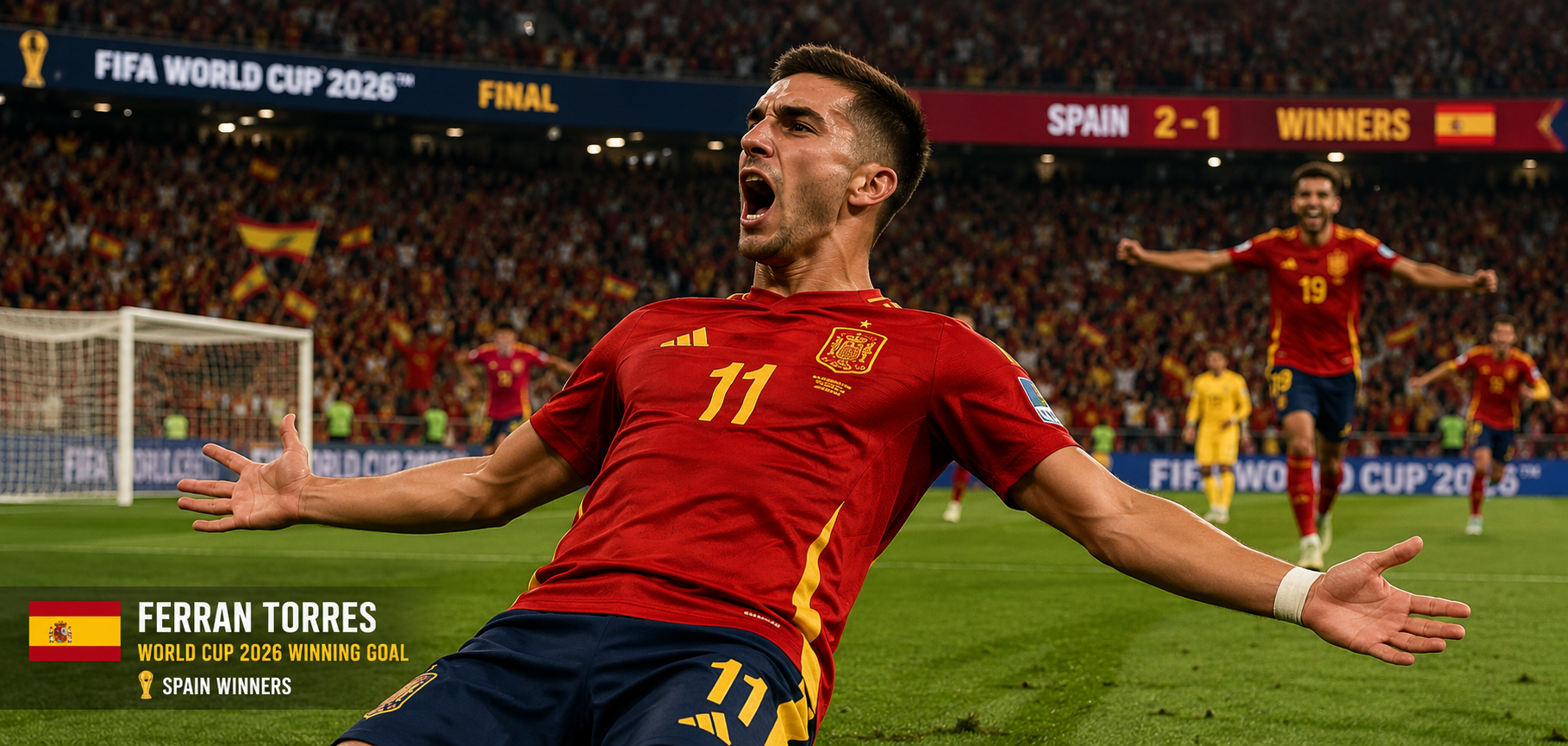
Spain are world champions once again. On Sunday, July 19, at MetLife Stadium in East Rutherford, New Jersey, Luis de la Fuente's side beat Lionel Messi's Argentina 1-0 after extra time to lift the 2026 FIFA World Cup — their second title after the 2010 triumph in South Africa. The only goal came from substitute Ferran Torres in the 106th minute, capping off a final that was tense, tactical, and, for long stretches, one-sided in Spain's favor.
How the Match Unfolded in the Spain vs Argentina World Cup Final 2026
For 90 goalless minutes, Spain dominated the ball and the chances but couldn't find a way past Argentina goalkeeper Emiliano Martínez, who put in one of the great goalkeeping performances in World Cup final history. Spain's young stars — Lamine Yamal and Nico Williams among them — tested him repeatedly, but Argentina's defense, built around a deep block and Martínez's shot-stopping, held firm through normal time.
Argentina, by contrast, barely threatened going forward. Messi, playing what is widely expected to be his final World Cup match, was heavily marked and touched the ball only a handful of times in the first half. The Albiceleste didn't manage a single shot in the first 90 minutes, relying instead on their defensive discipline and their well-established habit of grinding out late drama — a pattern that had carried them through several close games earlier in the tournament.
The game swung further in Spain's favor in stoppage time at the end of normal play, when Argentina midfielder Enzo Fernández was shown a second yellow card for a reckless challenge, reducing Argentina to ten men heading into extra time.
The Winning Goal: Ferran Torres Strikes in Extra Time
With Argentina defending deeper and deeper, Spain kept probing. Just 39 seconds into the second period of extra time, a passage of play involving full-back Pedro Porro and winger Nico Williams ended with the ball falling to Ferran Torres inside the box. The Barcelona forward needed only one touch, driving a low shot past Martínez to send the Spanish bench into delirium and finally break Argentina's resistance.
It was a fitting way for Spain to win their second title — much like their first, in 2010, came via a second-half-of-extra-time goal (Andrés Iniesta's famous strike against the Netherlands). This time, another Barcelona player wrote his name into World Cup history.
By the Numbers: Key Match Statistics
- 20 Shots to 0 On Target: Spain finished the match with 20 shots to Argentina's none on target — a striking illustration of the gulf in the final third.
- 11 Saves: Martínez made 11 saves, the most by any goalkeeper in a World Cup final over the last six decades.
- 1 Goal Allowed: Spain conceded just once across their entire eight-match World Cup campaign, a record for the fewest goals allowed by a champion.
- Historical Milestone: Messi became the first man to start three separate World Cup finals, and, at 39 years old, the oldest outfield player ever to start one.
- Defending Champion Streak: Argentina became the fourth defending champion in a row to lose the final, following Argentina itself in 1990, Brazil in 1998, and France in 2022.
Post-Match Scenes
The final whistle didn't end the drama. As Spain's players celebrated, tempers flared between the two squads: Argentina's Nahuel Molina and Leandro Paredes were both involved in physical confrontations with Spanish players, with Paredes eventually shown a red card for his role in the scuffle. It was an ugly coda to what had otherwise been a hard-fought, largely clean final between two heavyweight footballing nations.
What It Means Going Forward
For Spain, this is confirmation of a golden generation. A squad built around Barcelona's core — Yamal, Pedro, Cubarsí, and now Torres as the match-winner — has now delivered a World Cup to go alongside recent European Championship success, cementing this era as one of the most dominant in the nation's football history.
For Argentina, the result closes the book on an era defined by Messi. Barring a surprise change of heart, this is likely to be remembered as his final World Cup appearance — an outcome that will sting given how close his team came to a repeat title, and how quiet a night it was for arguably the greatest player of his generation.
Spain's triumph also extends a broader story: since 2010, five different nations have lifted the World Cup, underlining just how competitive and unpredictable the modern international game has become. For full statistical details, feel free to visit FIFA's official match report.
Want more World Cup 2026 coverage? Check out our breakdowns of the tournament's Best XI, the records that fell across the 48-team format, and what's next for Lionel Messi's international career.